Fragrance Line Planning That Feels Like a Brand
A first collection can look polished in product photos and still feel difficult to shop. The usual reason is not the fragrance itself. It is the absence of a system. Thoughtful fragrance line planning gives each scent, vessel, finish, and format a role, so customers understand the world of your brand before they read a single scent description.
You are not building a catalog of individual candles. You are creating a collection with rhythm: a few recognizable forms, a clear palette, and enough variation to invite discovery without turning the assortment into visual noise. For an early-stage founder, that focus also protects cash flow, simplifies production, and makes each product launch easier to merchandise.
Start With the Collection, Not the SKU
A common mistake is choosing a vessel because it is beautiful, then choosing a scent because it is popular, then adding a diffuser because the category seems necessary. Each decision may be sound on its own. Together, they can produce a line that feels assembled rather than designed.
Begin by defining the point of view your customer should feel when the product arrives. Is the brand warm and grounded, with smoked glass, soft neutrals, and wood-forward fragrances? Is it crisp and architectural, with clean labels, opaque white vessels, and mineral or citrus compositions? The answer is not a mood board exercise alone. It guides the practical decisions that follow: format count, finish selection, label scale, lid style, and the visual pace of your assortment.
Your collection should make a promise. A calm, elevated home fragrance brand may prioritize permanence and restraint. A seasonal gifting brand may lean into color shifts and collectible moments. Neither approach is inherently stronger. What matters is whether your choices repeat a recognizable idea.
Define a narrow launch thesis
Give your first release one sentence of direction. For example: “Modern rituals for slow evenings,” or “Bright, structured fragrance for sunlit rooms.” This is not customer-facing copy you need to print everywhere. It is a decision filter.
When considering a new vessel or scent, ask whether it belongs inside that sentence. If it does not, it may be a future collection rather than a launch item. Editing is one of the most valuable forms of brand building.
Build a Scent Architecture Customers Can Shop
A scent list is not yet a fragrance line. Architecture turns individual formulas into an assortment with clear roles.
For most emerging brands, three to five core fragrances is enough to create choice without spreading inventory too thin. The goal is contrast with cohesion. If every scent is sweet and gourmand, customers who prefer fresh or atmospheric profiles may leave without a fit. If every scent occupies a different aesthetic universe, the line loses its signature.
Consider building across fragrance families rather than chasing every trend. A well-balanced core might include a fresh profile, a warm profile, a wood or earth-driven profile, and a softer floral or skin-like option. Your exact mix depends on your customer and positioning. A coastal brand may make room for salt, citrus, and driftwood. A moody interiors brand may place incense, leather, black tea, and dark woods at the center.
Name scents as part of the product experience, not as an afterthought. Names should carry the same visual and emotional weight as the vessel. They can be evocative, but they should still help a customer anticipate the world they are entering. A collection of quiet, place-based names creates a different impression than a collection built around food, memories, or color.
Keep the scent descriptions consistent in structure. If one product reads like a poem and another reads like a technical formula, the collection will feel uneven. A concise format works well: an opening impression, a few defining notes, and the room or moment it suits.
Choose One Hero Form Before Expanding Formats
Your hero vessel is the form customers learn to associate with your brand. It should carry the core candle range confidently, photograph well from multiple angles, and leave enough label area for your identity to be legible.
Choose it before adding multiple sizes. A small vessel, a large vessel, and a travel tin can be useful, but too many silhouettes at launch weaken recognition. One strong form in one or two considered finishes often looks more premium than a scattered mix of jars, tins, and novelty shapes.
Scale can come later. Once the hero form has proven demand, you can introduce a larger version for gifting or a smaller format for discovery. The design question is whether the new size extends the same visual language. It should feel like a member of the family, not a separate business unit.
There is also an operational trade-off. One vessel style reduces wick testing variables, storage complexity, and purchasing risk. It gives you more time to refine the burn, packaging, and customer experience. Expansion is exciting, but repeatability is what supports growth.
Plan Candles and Diffusers as One Visual System
Candles and reed diffusers serve different rituals, yet they should look intentional beside one another on a shelf. The candle often brings warmth and occasion. The diffuser brings continuity and daily presence. Planning both formats together lets you create a more complete home fragrance offering without forcing customers to choose between unrelated aesthetics.
Start with shared visual anchors: a repeated color family, compatible glass finishes, aligned label proportions, and a consistent typographic hierarchy. The containers do not need to match exactly. In fact, they often should not. A candle vessel needs a grounded, substantial presence, while a diffuser bottle may benefit from a more refined neck or taller profile. The relationship matters more than literal sameness.
Reeds are part of the composition, too. Natural reeds can reinforce warmth and softness; black reeds can sharpen a more graphic, contemporary presentation. Treat them as a visible design element, especially when your products will live on open shelving, vanities, and entry tables.
At Dream Vessels, curated forms and coordinated finishes make this cross-category planning more intuitive. The aim is not to make every product identical. It is to give customers the confidence that your candle, diffuser, and refill belong to the same considered brand world.
Use Color and Finish With Restraint
Color is one of the fastest ways to establish a collection, and one of the easiest ways to overuse. A broad vessel palette may look exciting during sourcing, but too many colors can make a young brand feel less distinct. Restriction creates recognition.
Choose a core finish that can carry your evergreen range. This may be clear glass for a lighter, ingredient-led identity; matte white for a clean and modern one; amber for warmth and apothecary references; or black for a more dramatic, design-led statement. Then decide whether accent colors have a strategic role.
Seasonal color can work beautifully when the form remains fixed. Customers see a limited finish and still recognize the brand silhouette. That continuity makes seasonal releases feel collectible rather than disconnected. It also keeps your photography, packaging, and merchandising from needing a full reset every quarter.
Consider how finishes behave in real customer environments. Highly reflective glass can feel elevated but may photograph differently under warm light. Frosted or matte surfaces can look quieter and more tactile but may require careful label contrast. There is no universal best choice. Select the finish that supports both your visual identity and your production realities.
Set Launch Boundaries Before You Buy Inventory
Fragrance line planning becomes commercially useful when it includes limits. Decide in advance how many scents, vessels, and packaging variations you can support well. More options create more inventory positions, more testing, more labels, and more opportunities for inconsistency.
A focused first line might pair four scents with one candle vessel and one compatible diffuser bottle. That is enough range to tell a story while keeping forecasting manageable. If you offer every scent in every format, confirm that each product truly earns its place. Some fragrances may be exceptional in a candle but too subtle for passive diffusion. Others may shine as a diffuser and feel less dimensional when burned.
Think through price architecture as well. Your vessels, lids, carton, label materials, and fragrance load all shape the retail position customers perceive. Premium pricing is easier to support when the full object feels resolved: the vessel has presence, the packaging protects the experience, and the product photographs with clarity.
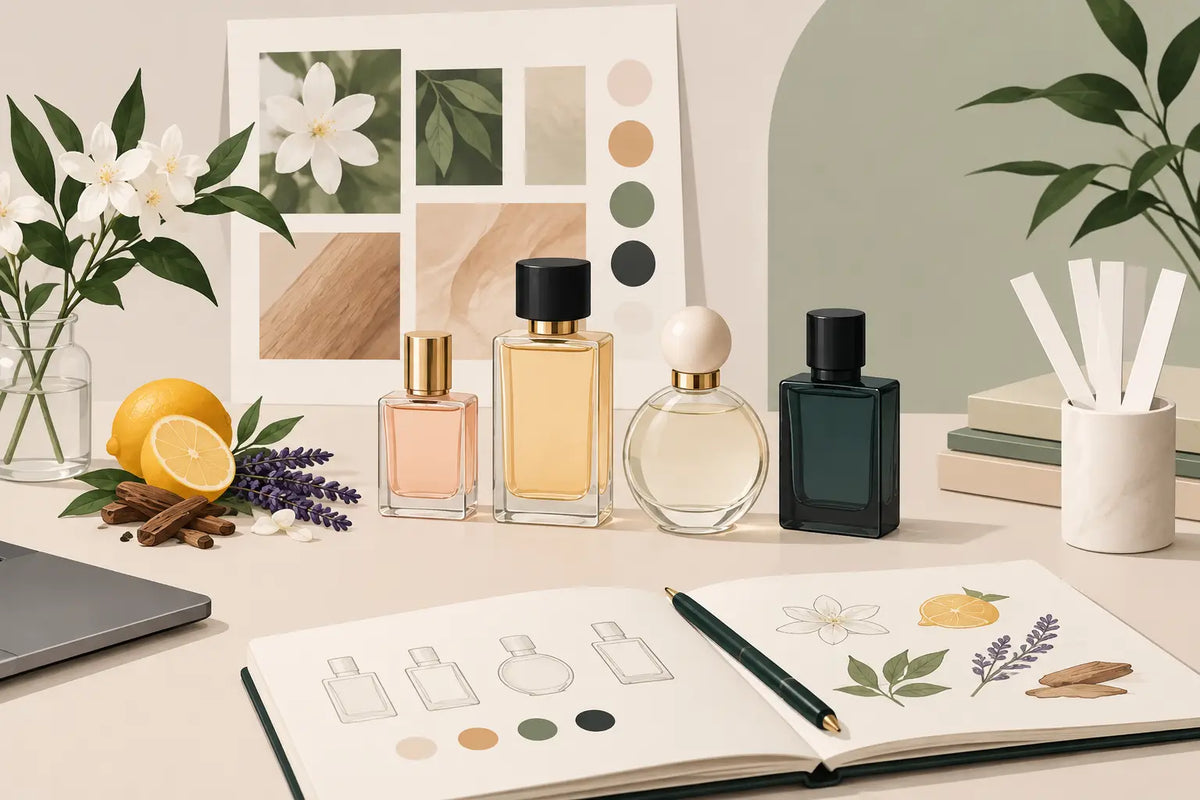
Before placing a larger order, create a physical lineup. Place every candle and diffuser side by side. View them from a few feet away, then photograph them together. Look for inconsistencies in height, label placement, cap color, and visual weight. The shelf test reveals more than a spreadsheet can.
Leave Room for the Second Chapter
The strongest launch collections do not try to say everything. They establish a point of view clearly enough that future additions have somewhere to go. Your second chapter might be a seasonal color story, a larger format, a discovery set, or a refill program. It should build on the original system, not correct it.
If you can place your products together and immediately see the same hand behind every decision, you have done the essential work. Let that clarity guide the next purchase, the next scent, and the next release.