Diffuser Bottle Closures That Complete the Design
A reed diffuser can have an exceptional fragrance, a beautiful bottle, and a carefully named scent. But if the finishing component feels like an afterthought, the product can lose its point of view before a customer even lifts the cap. Diffuser bottle closures do more than cover an opening. They frame the bottle, protect the fragrance between uses, and signal whether your collection belongs on a mass-market shelf or in a more considered home environment.
For fragrance founders, the closure is one of those small decisions with an outsized visual return. It sits at the point where glass, reeds, label, and fragrance meet. When it is right, the whole composition feels resolved. When it is wrong, even a strong vessel can look unfinished.
What diffuser bottle closures are designed to do
A diffuser closure has both a functional and a visual job. During shipping and storage, it helps secure the fragrance base inside the bottle. Once the product reaches the customer, it creates a clean opening for the reeds and gives the final diffuser its silhouette.
Most reed diffuser bottles are paired with a screw-top cap, often with a removable inner stopper or plug. The customer removes the plug, replaces the decorative cap, and inserts the reeds through the opening. This system offers practical protection before first use while allowing the finished diffuser to remain polished after setup.
The details matter. A closure that is too shallow can look undersized against a substantial vessel. One that is too tall can interrupt a low, architectural bottle shape. A finish that clashes with the label treatment can make a collection feel assembled rather than designed.
For that reason, closures should be selected alongside the vessel, not at the end of the development process. Think of them as part of the primary packaging system, just as you would a candle lid or carton.
Start with the bottle neck, then design outward
Compatibility is the non-negotiable starting point. Diffuser bottles are made with specific neck finishes and threading, so the closure must match the bottle's opening precisely. A cap may look nearly identical in a product image but still fail to screw on correctly, sit level, or provide the intended seal.
Before committing to a bottle-and-closure pairing, confirm the neck size, thread style, and recommended stopper configuration. Sampling is worth the time, especially if you are working with a new fragrance base, a heavier decorative cap, or a bottle that will travel through parcel shipping. A cap that fits in theory needs to perform in your actual product process.
This is also where founders can avoid a common sourcing problem: choosing a vessel from one collection and a closure from another without checking the specifications. Coordinated components remove that uncertainty and make it easier to maintain consistency as your line expands.
The stopper is part of the closure system
The inner plug may not be the most visible element, but it carries much of the practical responsibility. It helps prevent leaks and limits fragrance evaporation before the diffuser is opened by the customer. Depending on the bottle and closure format, it may be a plastic insert, a pressure-fit plug, or another sealing component designed for that neck.
Do not treat the stopper as interchangeable. Test it with your filled formula, not an empty bottle. Fragrance oils and diffuser bases can behave differently over time, particularly with warmer storage conditions and extended transit. A proper fit protects both the product and the unboxing experience.
Choose a finish that supports your brand language
Once fit is established, the design decisions become more interesting. Closure finishes establish contrast, continuity, and perceived value in a matter of seconds.
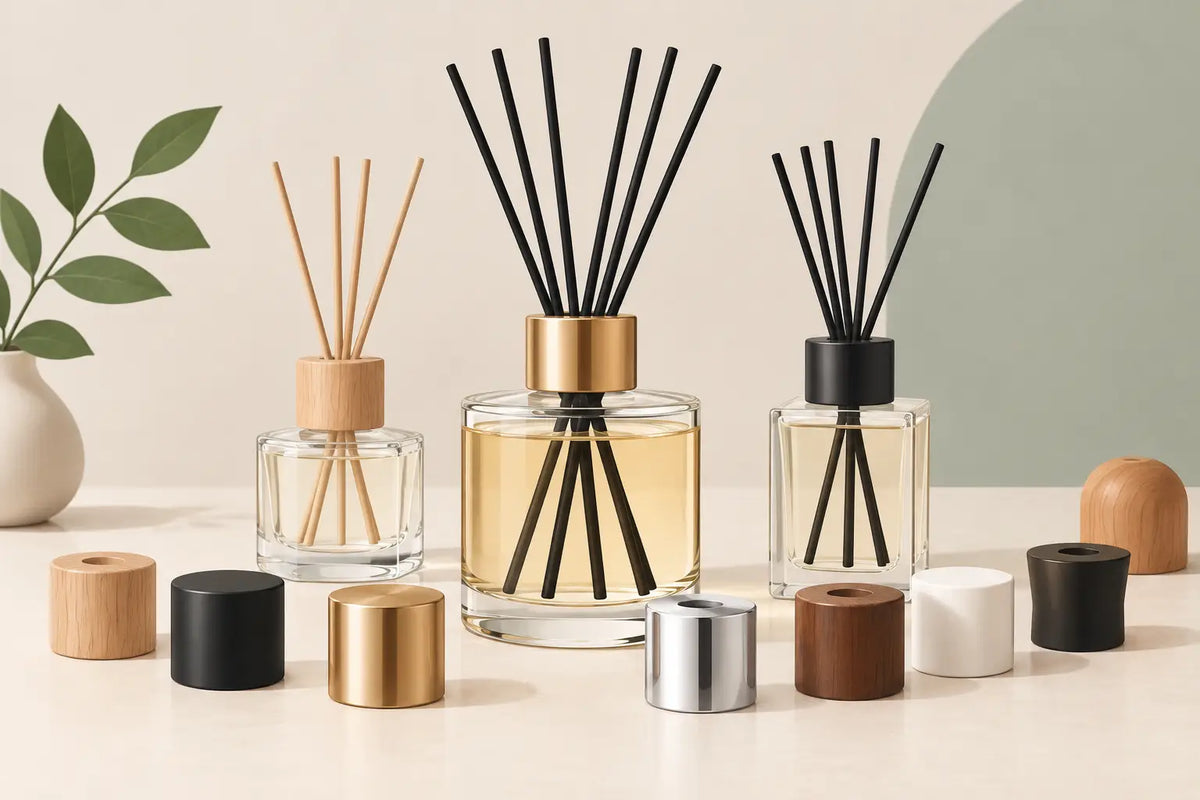
A matte black closure can give clear, amber, or opaque bottles a graphic, contemporary edge. It works particularly well for scent collections built around restraint, depth, and modern utility. Gold-toned closures bring warmth and a more decorative finish, particularly when paired with creamy labels, rich glass colors, or gifting-focused packaging. Silver or brushed metallic looks can feel crisp and architectural, while natural wood can soften a minimal vessel with an organic note.
There is no universal premium choice. The best finish depends on the rest of the composition. A gold cap on every bottle may feel elevated for a romantic, layered collection, but it could feel too formal for a quiet, mineral-inspired line. A black cap may strengthen a modern identity, yet make a pale, airy scent story feel visually heavy.
Instead of selecting components one at a time, assess them as a set: bottle color, closure finish, label stock, typography, reed color, and carton. You are building a shelf presence, not simply filling a bottle.
Match the closure profile to the vessel form
Color is only half the decision. Proportion has equal influence.
Round bottles often suit rounded, softly stepped, or gently tapered caps because the forms echo one another. Square and rectangular vessels can carry cleaner, more linear closures with confidence. A low, wide bottle may benefit from a cap with enough diameter to feel grounded, while a tall, narrow bottle can look more balanced with a slimmer profile.
Consider what happens when the reeds are in place. The closure becomes a visual base for the reed bundle, so its scale affects the entire vertical composition. A narrow neck with a wide cap can create an intentional, sculptural transition. A very small closure beneath a full set of reeds can look visually strained.
Photography is a useful test here. Set up a filled sample against the backdrop and props you expect to use for product imagery. Details that feel minor in hand can become conspicuous in a close crop or a collection shot. The goal is not to make every product identical. It is to ensure every product looks like it came from the same brand.
Design for the customer’s opening ritual
The customer experience is shaped by the sequence of opening, removing the stopper, placing the cap, and inserting the reeds. A diffuser should feel intuitive from the first touch. If the cap is difficult to unscrew, the stopper is hard to remove, or the opening is too tight for the intended reed bundle, the finishing details begin to work against the product.
Give particular attention to the number and thickness of reeds you plan to include. Reed quantity influences fragrance throw, but it also influences the apparent fullness of the bottle. The closure opening needs to accommodate that bundle without forcing customers to bend, splinter, or awkwardly arrange the reeds.
This is an area where visual ambition and usability need to stay in conversation. A very narrow opening may create a refined silhouette, but it may not suit a generous reed presentation. Conversely, a wider opening makes setup easier but can require a closure with stronger visual weight. Neither option is automatically better. The right choice depends on your vessel, scent strength, reed style, and intended price position.
Test diffuser bottle closures before you scale
A polished sample is not the same as production readiness. Before placing a larger order, fill several units and test the complete system under realistic conditions. Keep samples upright for a few weeks, inspect the neck and stopper for seepage, open and close the cap repeatedly, and evaluate how the materials look after contact with the fragrance formula.
If your products will ship, test them as shipped. Use the insert, carton, and protective materials you plan to sell with. A beautiful closure cannot compensate for a package that allows the bottle to move or the plug to loosen in transit.
Pay attention to finish durability as well. Metallic surfaces, painted treatments, and natural materials can each ask for different handling and storage practices. A premium component should retain its presence from your studio shelf to your customer's console table.
Build a closure strategy, not a one-off choice
The strongest home fragrance brands create recognition through repeated visual cues. That does not mean every diffuser needs the same bottle and cap. It means the choices should speak to one another.
You might use one closure finish across several vessel shapes to tie together a core collection. You might reserve a warmer metallic finish for limited editions and gifting. Or you may pair a signature black closure with dark reeds across diffusers, room sprays, and car fragrance formats to create a clear brand thread.
Dream Vessels approaches components with that larger picture in mind: permanent forms, considered finishes, and product systems that help a collection look intentional at every touchpoint. When you plan closures as part of the full line, future launches become easier to merchandise and more immediately recognizable.
The final closure choice should make your bottle feel complete before the first reed is placed. That quiet sense of resolution is what customers notice, remember, and bring into their homes.