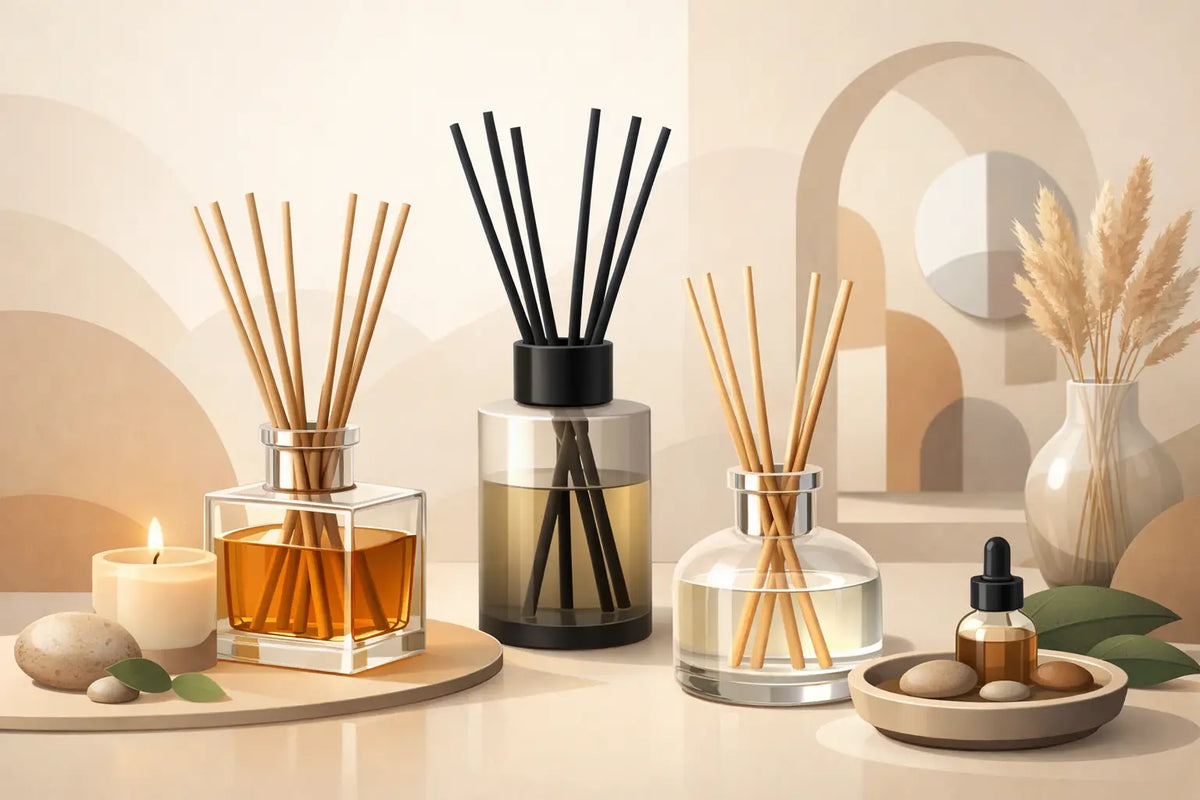
Reed Diffuser Bottle Guide for Elevated Brands
A reed diffuser is never just a fragrance format. It is a permanent visual presence on a nightstand, entry console, open shelf, or bathroom vanity. This reed diffuser bottle guide is designed for founders who want that presence to feel intentional from every angle - before a customer notices the scent, reaches for the reeds, or reads the label.
For a premium home fragrance line, the bottle establishes the product’s visual language. Its silhouette can feel architectural, soft, restrained, playful, or quietly luxurious. Its finish can pull a collection toward a warm, earthy palette or give it the crisp clarity of modern interiors. The right choice does more than hold diffuser base. It helps your brand occupy a distinct place in the customer’s home.
Start With the Role of the Reed Diffuser Bottle
A reed diffuser occupies different territory than a candle. Candles are often purchased for moments: a dinner party, a bath, a seasonal reset. A diffuser works in the background for weeks or months, making it one of the most visible and enduring objects in a fragrance collection.
That changes how you should select the vessel. Consider where the product will live and what it needs to communicate at a glance. A compact bottle with a low profile can feel right for a powder room or bedside table. A taller, more sculptural form makes a stronger statement in an entryway or living space. Neither is inherently more premium. The better choice is the one that supports your intended use case and visual position.
It also helps to define whether the diffuser is an extension of an existing candle collection or a category with its own identity. Matching every element can create a polished system, especially for a first launch. But a diffuser bottle does not need to be a miniature candle jar. A coordinated palette, related finish, or shared labeling structure can create cohesion while allowing each format to perform its own role.
Reed Diffuser Bottle Guide: Choose Form Before Color
Color is often what catches the eye first, but form does the deeper brand work. A strong silhouette remains recognizable in clear glass, matte black, or a soft neutral finish. It should feel considered even before a label is applied.
Round bottles feel approachable and versatile
Rounded forms bring softness to a fragrance line. They can feel classic, organic, and easy to place across multiple styles of home decor. This makes them especially useful for brands building broad appeal or creating a collection where fragrance names, label design, and color carry much of the personality.
The trade-off is familiarity. A standard round bottle can disappear if the rest of the presentation is not equally deliberate. Refined labeling, a thoughtful cap treatment, and reeds that complement the palette can turn a simple form into a finished product rather than a generic component.
Square and rectangular forms create structure
Angular bottles bring order and presence. Their clean planes photograph beautifully, line up neatly in retail displays, and lend themselves to typography-led labels. For a modern fragrance brand, a square diffuser can signal restraint and confidence without needing excessive decoration.
These forms are particularly effective when your candle vessels have clean, architectural proportions. They can also help distinguish a collection positioned around minimal interiors, elevated gifting, or a more editorial visual world. Keep in mind that sharp geometry can feel more formal, so it may not suit a brand built around botanical softness or playful color.
Tall, narrow forms emphasize the reeds
The bottle and reeds should be considered as one composition. A slender, vertical vessel creates a longer visual line and makes the reeds part of the product’s display. It can feel elegant and elevated, particularly when paired with a restrained label and a refined finish.
Balance matters here. A bottle that is too narrow or tall may look beautiful but can be less stable in high-traffic spaces. It can also make filling, shipping, or fragrance oil performance more sensitive to the exact bottle opening and reed selection. Test the full product, not the vessel alone.
Select Capacity Based on Placement and Price Positioning
Bottle capacity affects more than how much diffuser base you can fill. It influences the product’s footprint, perceived value, shipping profile, price architecture, and how long the customer expects the fragrance to last.
Smaller diffuser bottles are well suited to intimate spaces and introductory price points. They can work beautifully in gift sets, travel-inspired collections, or as an accessible first purchase for customers discovering your brand. Larger formats deliver more visual impact and can support a higher price point, but only if the fragrance experience, packaging, and refill strategy support that promise.
Avoid choosing capacity solely because it is common in the category. Start with the customer moment. Is this a small luxury for a guest bath? A signature home scent designed to anchor an open-concept living area? A refillable object meant to remain on display? The answer should shape the format.
The Neck Finish Determines More Than You Think
The opening of a reed diffuser bottle is a functional detail with major design consequences. It affects how easily the bottle is filled, which closure components fit, how the reeds sit, and the overall proportion of the finished product.
A wider neck can create a more relaxed, generous look and accommodate a fuller bundle of reeds. It may also allow stronger fragrance diffusion, depending on the base, reed material, and number of reeds used. A narrower neck often feels more tailored and reduces the visual dominance of the opening, but it may require more careful testing to achieve the diffusion level you want.
The collar, stopper, plug, or cap should never feel like an afterthought. These components frame the neck and can either strengthen the collection or interrupt it. A diffuser in warm amber glass may call for a natural, grounded accent. A sleek black or white bottle may benefit from a tonal closure that maintains a clean silhouette. Build your selections as a composition, not as separate parts ordered at the end.
Finish Sets the Mood Before the Scent Does
Glass finish is one of the fastest ways to establish a collection’s emotional temperature. Clear glass feels open, crisp, and ingredient-forward. It is a strong choice when the diffuser liquid, reed color, or label design is part of the visual story.
Amber and smoked tones introduce warmth and depth. They can feel apothecary-inspired, moody, or quietly nostalgic, depending on the label and closure. Opaque white, black, and soft neutral finishes create a more controlled presentation. They are useful when you want the vessel to read as decor first and packaging second.
There is a practical dimension as well. Darker or opaque finishes can help conceal discoloration that may develop in certain fragrance formulations over time. Clear bottles ask more of the formula and filling process because every detail remains visible. If your brand promises a pristine, minimal presentation, test for clarity, color stability, and residue before committing to a production run.
Build a System, Not a Single SKU
The most memorable fragrance brands do not make each launch feel unrelated. They create recognition through repeated forms, finishes, proportions, and details. Your reed diffuser can participate in that system without becoming identical to every candle vessel you offer.
Choose one or two visual anchors to repeat across formats. This could be a warm ivory finish, a shared label width, a consistent type hierarchy, or a family of rounded forms. Then allow variation where it serves the product. A candle may be low and substantial, while its corresponding diffuser is tall and composed. Together, they should look like they belong in the same room.
This approach also makes merchandising easier. Coordinated vessels photograph better in sets, create stronger shelf rhythm, and encourage customers to build a layered home fragrance ritual. For founders expanding beyond candles, this is where Dream Vessels can become a sourcing partner rather than simply a place to buy containers.
Test the Finished Experience, Not Just the Sample
A beautiful empty bottle is only the beginning. Fill samples with your actual diffuser base and fragrance load. Test your selected reeds over time. Watch for leakage, evaporation, label adhesion issues, finish wear, and changes in liquid appearance. Assess the bottle on the surface where a customer is likely to use it, not only on a studio table.
Pay attention to the unboxing moment, too. The reeds, closure, bottle, label, and protective packaging should arrive as one clear experience. If a customer has to guess how to remove a stopper or wonders whether the bottle is meant to be displayed with a cap, the presentation loses some of its authority.
The best diffuser bottle is not necessarily the most ornate or the most unusual. It is the form that makes your scent, design language, and price point feel inevitable. Choose a vessel that earns its place in the room, then give it the components and finishing details to become part of the home rather than another object on the counter.