Best Tins for Travel Candles for Modern Brands
A travel candle is often the first physical touchpoint between a customer and your fragrance brand. It slips into a weekend bag, appears in a gift set, and earns a place on a hotel nightstand. The best tins for travel candles do more than make that experience portable. They make a small format feel intentional, premium, and distinctly yours.
For founders, the question is not simply which tin holds wax. It is which form supports the way you want your collection to be perceived. A travel tin can be an accessible entry price, a discovery-size version of a signature scent, or a limited-edition vehicle for a seasonal color story. Choosing well starts with function, then moves into proportion, finish, and the visual system around it.
What Makes the Best Tins for Travel Candles?
A strong travel candle tin balances four needs: portability, candle performance, shelf presence, and brand consistency. Missing any one of them can make a product feel less considered. A beautiful vessel that dents in transit creates a poor unboxing moment. A practical tin with a weak visual identity can disappear beside more polished competitors.
Start with a tin designed for candles rather than a generic storage container. The vessel should have a fitted lid, a stable base, and a shape that supports an even, controlled burn when paired with the right wax and wick. Metal conducts heat differently than glass, so the exterior can become warm or hot during use. Clear safety labeling and thorough burn testing are part of the product design, not an afterthought.
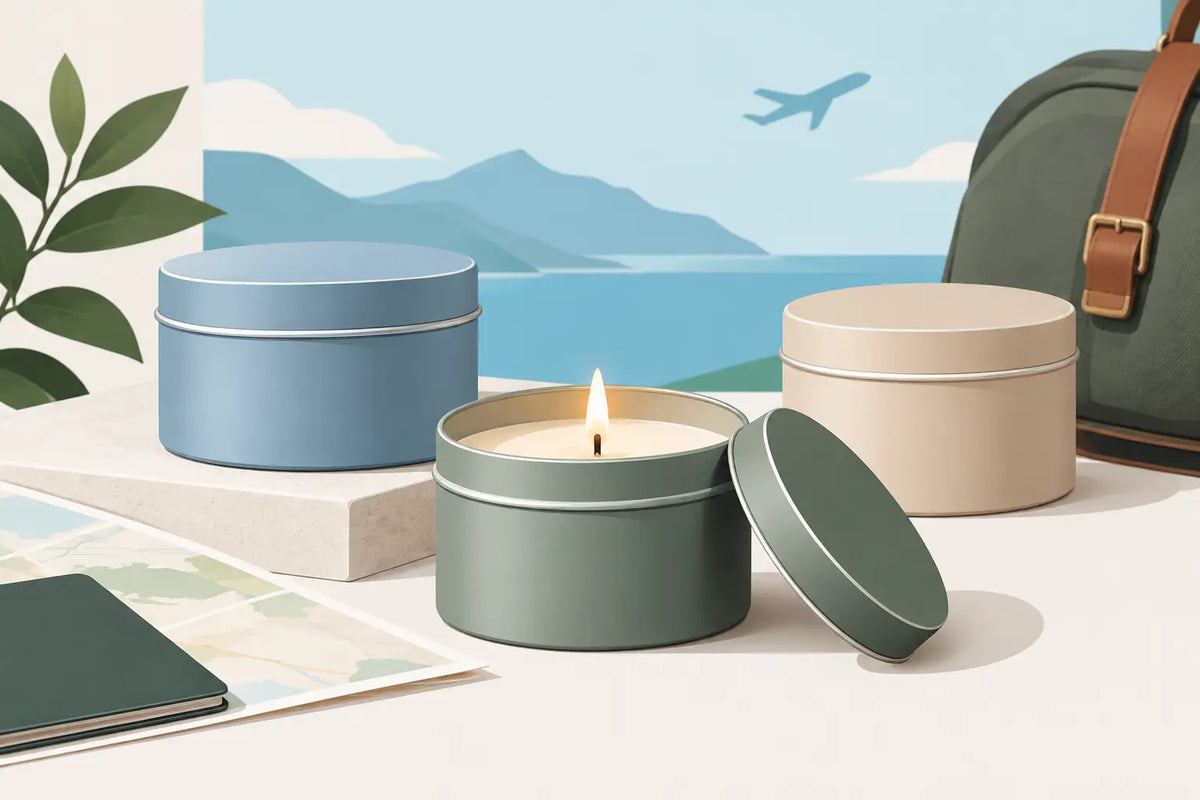
The lid matters more than it may seem. It protects the wax surface in transit, helps preserve scent between uses, and gives the customer a clean way to extinguish and store the candle once it has cooled. A snug lid also makes tins especially useful for discovery sets, event favors, subscription boxes, and giftable fragrance pairings.
Choose a size with a clear role
Travel tins typically work best when their size is tied to a specific merchandising purpose. A smaller tin can introduce customers to a scent without asking them to commit to a full-size candle. A more generous format can serve as a compact everyday candle for desks, bathrooms, guest rooms, and getaways.
There is no universal best size. It depends on your fragrance load, wax system, wick series, desired burn time, and retail positioning. A tin that looks compact may still carry meaningful visual weight if its diameter is broad and low. A taller, narrower silhouette can feel more gift-like, but it requires especially careful wick testing to prevent tunneling or overheating.
Rather than adding several near-identical sizes, choose one travel format with a defined place in your assortment. It might be your scent sampler, your impulse-purchase candle, or the companion piece to a larger vessel. That clarity makes buying easier for customers and merchandising easier for your brand.
Form Sets the Tone Before the Candle Is Lit
Tins are often treated as the casual alternative to glass. That is a missed opportunity. Their clean geometry and tactile metal finish can make them feel modern, architectural, and quietly collectible.
A low-profile round tin tends to read as approachable and versatile. It is an easy fit for a relaxed, coastal, botanical, or everyday fragrance line. A taller straight-sided tin can bring a more tailored, contemporary point of view, especially when paired with restrained typography and a centered label. Seam details, rim thickness, and lid profile all influence the final impression.
Keep proportion in view when building a family of products. If your full-size candles use soft curves and warm neutrals, a sharply industrial tin in a bright primary color may feel disconnected, even if it performs beautifully. The travel format should extend the brand world, not introduce a competing one.
This is where collection planning becomes valuable. Think of the tin as part of a larger composition: the candle vessel, diffuser bottle, refill format, care tools, outer carton, and photography palette. When forms and finishes speak to one another, a small travel candle becomes evidence of a brand with a point of view.
Select Finishes for Your Brand, Not Just the Shelf
Finish carries emotional weight. Matte black can feel editorial, moody, and confident. Soft ivory or sand can suggest calm, warmth, and modern restraint. Brushed metallic tones can bring polish to a holiday edit or a more elevated gifting concept. Gloss can feel playful and graphic, while matte surfaces often suit brands built around quiet luxury.
The trade-off is practical as well as visual. Dark finishes may show dust, wax smudges, or label misalignment more readily in product photography. Very light finishes can require thoughtful shipping and handling to keep the presentation pristine. Metallic tins may reflect studio lights and store lighting differently than expected, so photograph samples before committing to a campaign look.
Color should also work across scent names and seasonal launches. If every fragrance label must fight against a bold vessel color, the collection can become visually noisy. Neutral tins offer flexibility and allow the label system to carry the storytelling. A selective color palette, on the other hand, can create a memorable collection when each shade has a clear role.
For example, a core line may remain in a permanent matte neutral, while a limited summer release introduces a softened citrus tone. That approach protects recognition while giving customers a reason to notice what is new.
Design the Label and Lid as One System
The compact surface area of a travel tin calls for discipline. Avoid trying to place every brand message, scent note, safety instruction, and social handle on the front label. The strongest labels create hierarchy. Your brand name, scent name, and essential product detail should be easy to find at a glance. Supporting copy can move to the base label, outer carton, or insert.
A centered front label gives a classic, composed look. A smaller label positioned with generous negative space can feel more design-forward. Direct printing may offer a highly refined result at scale, but labels are often more flexible for early-stage brands testing scent names, colorways, and seasonal concepts.
Do not overlook the top of the lid. A lid label, subtle mark, or coordinated seal turns the closed candle into a finished object. It also improves the presentation when tins are stacked in a retail display or photographed from above. In a gift set, this small detail can make the difference between a collection that feels assembled and one that feels art directed.
Test for Travel, Not Just for the Worktable
A travel candle needs to survive more than a successful burn test. It should arrive with its lid secure, its label intact, and its wax surface looking clean after normal handling. Test filled tins in the conditions your customers will encounter: a warm delivery truck, a jostled mailer, a crowded suitcase, and repeated opening and closing.
Start with a complete sample: finished vessel, final wax, wick, fragrance, lid, label, and intended packaging. Evaluate how the product looks after it has been moved around, not only when it is fresh from the pour. Watch for surface frosting, lid scuffs, label lifting, dents, and scent transfer to neighboring packaging materials.
Burn testing remains essential. Test each fragrance and color combination in the final tin, using your actual production process. Record flame height, melt pool development, container temperature, soot, wick stability, and end-of-life behavior. A wick that performs well in one scent may not perform the same way in another. The best-looking tin is never the right choice if the finished candle does not perform safely and consistently.
Build a Travel Tin Into the Customer Journey
Travel tins work hardest when they are planned as part of a wider customer journey. They can be sold individually, bundled as a discovery trio, offered as a gift-with-purchase, or paired with a matching diffuser for a compact home fragrance set. Their lower price point also makes them a thoughtful way to invite new customers into a premium brand.
For emerging makers, a single tin style can simplify launch planning. For established brands, it can create a flexible format for scent previews and limited runs without disrupting a permanent vessel program. Dream Vessels approaches this decision through collection cohesion: selecting components that allow a founder to build across categories while preserving one visual language.
The most effective travel tin is not merely smaller. It is recognizably part of your brand from the lid down. Choose a form customers want to carry, a finish they want to display, and a system that leaves room for the next scent, season, or product category you plan to introduce.